
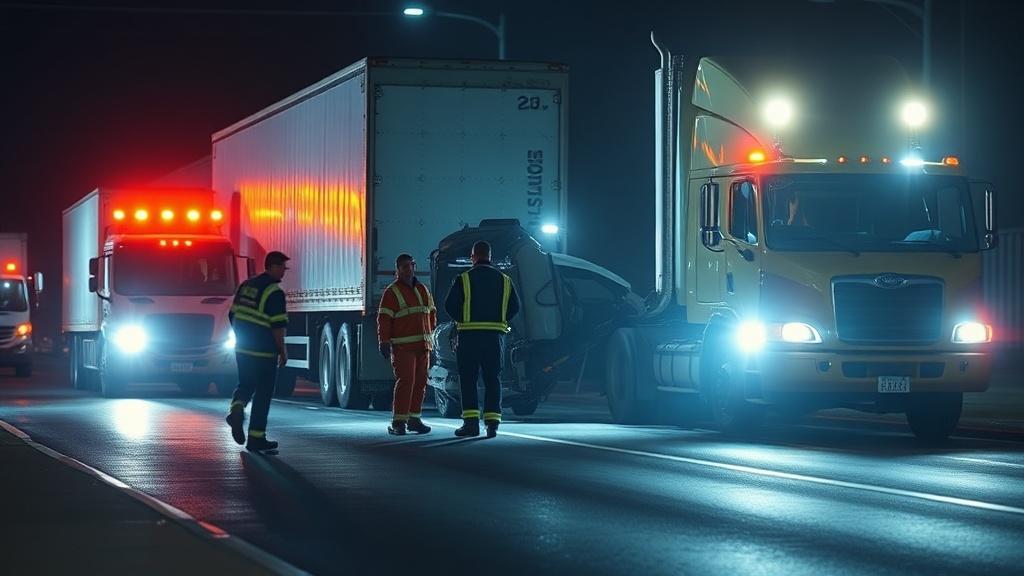
Complete employer guide to DOT post-accident drug and alcohol testing. Covers qualifying accidents by agency, testing windows, decision matrix, step-by-step checklists, common mistakes, and consequences of non-compliance.
Audio Summary
1:46
Listen: DOT Post-Accident Testing
Narrated by Diana · Driver Relations & Compliance Advocate
0:00
1:46
Click play to load audio
What Qualifies as a DOT Accident
Not every crash or incident triggers DOT post-accident testing. The definition of a qualifying accident varies by DOT agency, and employers must understand their specific agency's criteria to make correct testing decisions. Misidentifying an accident—either testing when it is not required or failing to test when it is—can both create compliance problems.
FMCSA (Commercial Motor Vehicles)
Under 49 CFR Part 382.303, FMCSA defines an accident as an occurrence involving a commercial motor vehicle on a public road that results in one or more of the following:
- A fatality (any death, regardless of who receives a citation)
- A citation issued to the CMV driver AND bodily injury to any person requiring immediate medical treatment away from the scene
- A citation issued to the CMV driver AND one or more vehicles incurring disabling damage requiring tow-away
If a fatality occurs, the CMV driver must always be tested regardless of whether a citation is issued. For the other two criteria, testing is required only if the CMV driver receives a citation for a moving violation arising from the accident.
FTA (Public Transit)
FTA uses a different threshold. Under 49 CFR Part 655, post-accident testing is required when an accident involves a transit vehicle and results in a fatality, or when the operator receives a citation for a moving violation and there is bodily injury requiring immediate transport for medical treatment or any vehicle has disabling damage. FTA also has a unique non-fatal accident threshold that includes any event involving a transit revenue vehicle.
FRA, FAA, PHMSA & USCG
Each of these agencies has distinct qualifying criteria. FRA uses specific thresholds for reportable rail incidents. FAA requires testing after aircraft accidents and certain defined incidents. PHMSA requires testing after pipeline incidents meeting specific release or damage thresholds. USCG mandates testing after serious marine incidents involving casualties, significant property damage, or environmental release. Employers must reference the specific regulatory definitions for their agency.
The 8-Hour and 32-Hour Testing Windows
Once a qualifying accident has occurred, strict testing deadlines begin immediately. These windows start from the time of the accident, not from the time you determine testing is needed. Understanding and acting within these deadlines is one of the most critical aspects of post-accident compliance.
Alcohol Testing: 8-Hour Window
The alcohol test must be administered within 8 hours of the accident. If the test cannot be administered within 2 hours, the employer must prepare and maintain a record documenting the reason for the delay. If the test is still not administered within 8 hours, the employer must cease attempts and document why the test was not administered.
The employee must not consume alcohol for 8 hours following the accident or until a post-accident alcohol test is administered, whichever comes first. Violation of this instruction is treated as a refusal to test.
Drug Testing: 32-Hour Window
The drug test specimen must be collected within 32 hours of the accident. If the specimen is not collected within this window, the employer must cease attempts and prepare a detailed written record explaining why collection was not performed. There is no grace period. Once the 32-hour deadline has passed, a valid post-accident drug test cannot be conducted for regulatory purposes. The employee must remain available for testing throughout this period. Leaving the scene or failing to remain available may be considered a refusal to test.
Post-Accident Testing Decision Matrix
Use the following criteria to determine whether post-accident testing is required under FMCSA regulations. This matrix applies specifically to CDL drivers operating commercial motor vehicles.
Testing IS Required
- Any accident involving a fatality, regardless of who is cited or at fault
- Driver receives a citation for a moving violation AND any person is transported for immediate medical treatment away from the scene
- Driver receives a citation for a moving violation AND any vehicle sustains disabling damage requiring tow-away from the scene
Testing is NOT Required
- Fender-bender with property damage only and no citation issued to the CMV driver
- Bodily injury occurs but the CMV driver does not receive a citation
- Vehicle damage occurs but is not disabling (vehicles are driven from the scene) and no citation is issued
- The CMV driver was not performing a safety-sensitive function at the time of the accident
When in doubt, many compliance experts recommend testing. Conducting a test that was technically not required under DOT rules is far less problematic than failing to test when testing was mandatory. However, employers should not rely on post-accident testing as a substitute for reasonable suspicion testing protocols.
Step-by-Step Employer Checklist After an Accident
When an accident occurs, time is critical. Use this checklist to ensure every required step is completed within the regulatory deadlines.
- Ensure safety first. Address injuries, secure the scene, and contact emergency services as needed before initiating any testing procedures.
- Instruct the driver not to consume alcohol. Immediately inform the driver that they must not use alcohol for 8 hours following the accident or until tested.
- Determine if the accident qualifies for testing. Apply the decision matrix above. If a fatality occurred, testing is always required. Otherwise, assess whether a citation was issued and whether there was bodily injury requiring off-scene treatment or disabling vehicle damage.
- Contact your C/TPA or testing provider immediately. Call ABW Compliance Services or your designated provider to dispatch a collector. The sooner you call, the more likely you are to meet both testing deadlines.
- Instruct the driver to remain available for testing. The driver must not leave the area or become unavailable. Document all instructions given to the driver.
- Administer the alcohol test first. Because the alcohol testing window is shorter (8 hours), prioritize the breath alcohol test. If the test cannot be administered within 2 hours, begin documenting the delay.
- Collect the drug test specimen. The urine specimen must be collected within 32 hours. Use only a qualified DOT collector following Part 40 procedures.
- Document everything. Record the date and time of the accident, the time you determined testing was required, the times you contacted the testing provider, and the times the tests were administered. If any deadline is missed, document exactly why.
- Report the results. Once results are received, take appropriate action. Report any positive results or refusals to the FMCSA Clearinghouse within the required timeframe.
Common Mistakes Employers Make
Post-accident testing is one of the most error-prone areas of DOT compliance. In our experience managing thousands of post-accident tests, these are the most frequent mistakes we see employers make.
Missing the testing windows
The most common and most consequential mistake. Employers who do not have a rapid-response testing provider on call often cannot locate a qualified collector quickly enough, especially during nights, weekends, or holidays. Once the 8-hour or 32-hour window closes, the testing opportunity is lost permanently.
Failing to document delays or missed tests
When a test cannot be performed within the required window, DOT regulations require a written explanation. Many employers simply skip the test without creating any documentation. During an audit, the absence of both a test result and a written explanation is a clear violation.
Testing non-qualifying accidents
Some employers test after every accident regardless of whether it meets DOT criteria. While this may seem conservative, it can create legal issues under state drug testing laws that require specific justification for testing. It can also desensitize the process and lead to procedural shortcuts.
Allowing the driver to leave the scene
The driver must remain available for testing. If the driver leaves the area without being tested, it may be treated as a refusal. Employers must provide clear, documented instructions to the driver to remain available.
Not instructing the driver to refrain from alcohol use
The driver must be explicitly told not to consume alcohol for 8 hours or until tested. If the driver consumes alcohol before the test, the test result may be invalidated, and the driver may face a refusal determination.
Using non-DOT collection procedures
A post-accident test must follow all Part 40 procedures. Using a hospital or urgent care facility that is not familiar with DOT collection requirements often results in procedurally flawed tests that cannot be used for DOT purposes.
Consequences of Failing to Test
The consequences of failing to conduct a required post-accident test are severe and far-reaching. Under DOT regulations, if an employer does not administer a post-accident test when one was required, the untested employee is treated as if they had refused to test. A refusal carries the same consequences as a positive result.
For CDL holders, a refusal means immediate removal from safety-sensitive duties, a mandatory SAP evaluation, and a report to the FMCSA Clearinghouse that will follow the driver for at least five years. The driver cannot return to safety-sensitive functions until the full return-to-duty process is completed.
For employers, the consequences include civil penalties under FMCSA's published schedule at 49 CFR Part 386, Appendix B: a maximum of $19,246 for the carrier under paragraph (a)(3), or $4,812 where it is the driver who violated the rule under paragraph (a)(4), as amended through July 21, 2026. Those are ceilings rather than typical assessments. The consequences also include adverse audit findings and potential out-of-service orders. Perhaps most critically, if the untested driver is later involved in another accident, the employer's failure to test creates enormous liability exposure in civil litigation.
Insurance carriers are also increasingly scrutinizing post-accident testing compliance. A pattern of missed tests can lead to increased premiums, policy exclusions, or even cancellation of coverage.
How ABW Helps After an Accident
Call ABW Compliance Services as soon as an accident happens, so the testing windows in 49 CFR 382.303 can still be met. Here is what happens:
- A compliance specialist takes your call.
- We walk you through the decision matrix to confirm whether testing is required.
- If testing is required, we dispatch a DOT-qualified collector to the driver's location, dispatched as soon as the determination is made.
- The collector administers the breath alcohol test and collects the urine specimen following all Part 40 procedures.
- All chain-of-custody documentation is completed and the specimen is shipped to a SAMHSA-certified laboratory.
- We track the results and notify you as soon as they are available, handling MRO review through our contracted Medical Review Officers.
- If a result is positive, we initiate the Clearinghouse reporting process and guide you through next steps.
Frequently Asked Questions
Can a hospital drug test satisfy the DOT post-accident requirement?
+
Generally no. Hospital or emergency room drug tests are not conducted under DOT Part 40 procedures. They typically use different testing panels, different collection methods, and are not reviewed by a DOT-qualified MRO. A DOT post-accident test must be performed by a qualified DOT collector using the Federal CCF and sent to a SAMHSA-certified laboratory.
What if the driver is injured and cannot be tested immediately?
+
If the driver is injured and requires immediate medical attention, medical treatment takes priority. However, the testing windows still apply. If the driver is conscious and able to provide a specimen, the test should be administered as soon as medically practical. If the driver cannot provide a specimen, the employer documents why the test could not be performed. FMCSA also accepts a breath or blood alcohol test, or a urine drug test, done by law enforcement or public safety officials with independent authority, if the employer obtains the results (49 CFR 382.303(g)).
Does the driver have to be at fault for post-accident testing to apply?
+
Under FMCSA, fault is not the determining factor for fatality-related testing. If any fatality occurs in an accident involving a CMV, the driver must be tested regardless of fault. For non-fatal qualifying criteria, the driver must receive a citation for a moving traffic violation. Being at fault and receiving a citation are related but not identical concepts.
What if the accident occurs in a remote location with no nearby collection sites?
+
This is why it helps to have a testing partner who can send a mobile collector to the driver's location. If a test still cannot be given in time, 49 CFR 382.303(d) tells the employer to stop trying — at 8 hours for alcohol and 32 hours for drugs — and keep a record of why the test was not done.
Need Post-Accident Testing Support?
ABW Compliance Services arranges DOT post-accident testing. Call as soon as an accident happens.
Get Post-Accident SupportGet a Free Quote
Recent Posts
- Return-to-Duty Process: Complete Guide for Employers (2026)May 12, 2026
- Reasonable Suspicion Training: What Supervisors Need to Know (2026)May 12, 2026
- DOT Compliance for Owner-Operators: Getting Started Guide (2026)May 12, 2026
- Oral Fluid Testing: DOT-Approved Saliva Drug Testing Guide (2026)May 12, 2026
- How Long Do Drugs Stay in Your System? Detection Windows for DOT TestingMay 12, 2026