
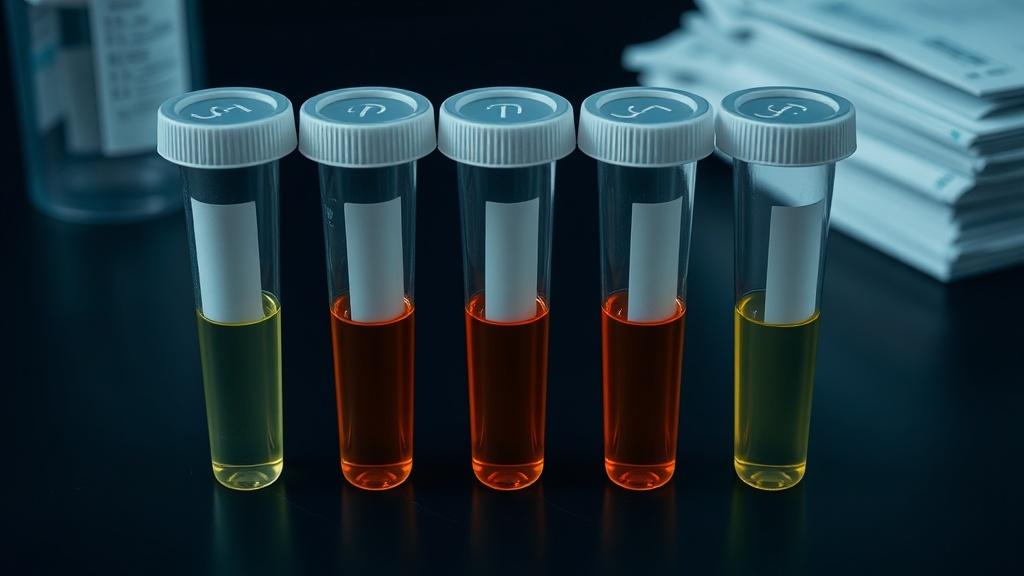

Complete guide to the DOT 5-panel drug test covering all substances tested, cutoff levels for screening and confirmation, the proposed fentanyl addition, oral fluid testing, MRO review, and detection windows.
Audio Summary
2:22
Listen: DOT 5-Panel Drug Test Guide
Narrated by Sarah · Compliance Technology Specialist
0:00
2:22
Click play to load audio
What Is the DOT 5-Panel Drug Test?
The DOT 5-panel drug test is the standardized drug screening required by the U.S. Department of Transportation for all safety-sensitive employees across six federal agencies. Unlike non-DOT workplace testing where employers choose their own panels, the DOT panel is mandated by federal regulation under 49 CFR Part 40 and cannot be modified by employers. Every DOT-regulated employer must use this exact panel — no substances can be added or removed.
The term "5-panel" refers to the five categories of controlled substances that are screened. Within those five categories, laboratories actually test for multiple specific analytes, making the test far more comprehensive than the name suggests. The panel was significantly expanded in 2018 when semi-synthetic opioids (hydrocodone, hydromorphone, oxycodone, and oxymorphone) were added to the opioid category, and MDMA was added to the amphetamines category.
The 5 Substance Categories Tested
Each category includes specific analytes that laboratories screen for and confirm. Here is a detailed breakdown of everything the DOT 5-panel tests for:
1. Marijuana (THC)
The test screens for delta-9-tetrahydrocannabinol-9-carboxylic acid (THC-COOH), the primary metabolite of marijuana. Cannabis remains a Schedule I substance under federal law, and a positive THC result is a DOT violation regardless of any state legalization — whether medical or recreational. The DOT has issued explicit guidance that no state marijuana law can supersede federal DOT testing requirements. This applies to all forms of cannabis including edibles, oils, and CBD products that contain THC above trace levels.
2. Cocaine
The test screens for benzoylecgonine, the primary metabolite of cocaine. This covers all forms of cocaine including powder cocaine, crack cocaine, and any preparation containing cocaine. There is no legitimate medical prescription for cocaine that would result in a negative verification by an MRO, though in extremely rare cases, cocaine-derived anesthetics used in certain medical procedures could theoretically produce a positive result. The MRO evaluates each case individually.
3. Amphetamines
This category tests for amphetamine, methamphetamine, MDMA (ecstasy/molly), and MDA. Prescription medications like Adderall (amphetamine salts) and Desoxyn (methamphetamine) can produce positive results in this category. The MRO will evaluate whether the donor has a valid prescription that explains the laboratory finding. For methamphetamine, the confirmation test also distinguishes between d-methamphetamine (the illicit form) and l-methamphetamine (found in some over-the-counter inhalers).
4. Opioids (Expanded Panel)
The opioid category is the most comprehensive on the DOT panel and tests for seven specific analytes: codeine, morphine, heroin (detected via the metabolite 6-acetylmorphine/6-AM), hydrocodone, hydromorphone, oxycodone, and oxymorphone. The expansion to include the four semi-synthetic opioids (hydrocodone, hydromorphone, oxycodone, oxymorphone) was one of the most significant updates to the DOT panel in its history. Many of these substances have legitimate medical uses, making MRO review particularly important for this category.
5. Phencyclidine (PCP)
PCP, also known as angel dust, is the fifth substance category on the DOT panel. While PCP use is less common today than in previous decades, it remains on the panel due to its severe effects on perception, judgment, and motor function — all critical for safety-sensitive transportation work. There is no legitimate medical prescription for PCP that would result in a negative verification.
Cutoff Levels for Screening & Confirmation
DOT drug testing uses a two-step laboratory process: an initial immunoassay screen followed by a confirmation test using gas chromatography/mass spectrometry (GC/MS) or liquid chromatography/ tandem mass spectrometry (LC/MS/MS). Each step has specific cutoff concentrations set by federal regulation. A specimen must exceed the screening cutoff to be reported as presumptive positive, and then must also exceed the confirmation cutoff for the specific analyte to be reported as confirmed positive.
| Substance | Initial Screen (ng/mL) | Confirmation (ng/mL) |
|---|---|---|
| Marijuana (THC-COOH) | 50 | 15 |
| Cocaine (Benzoylecgonine) | 150 | 100 |
| Amphetamine | 500 | 250 |
| Methamphetamine | 500 | 250 |
| MDMA / MDA | 500 | 250 |
| Codeine | 2000 | 2000 |
| Morphine | 2000 | 2000 |
| 6-AM (Heroin) | 10 | 10 |
| Hydrocodone | 300 | 100 |
| Hydromorphone | 300 | 100 |
| Oxycodone | 100 | 100 |
| Oxymorphone | 100 | 100 |
| PCP | 25 | 25 |
Note: Cutoff levels shown are for urine specimens. Oral fluid cutoff levels differ and are specified separately in 49 CFR Part 40.
The Proposed Fentanyl Addition (6-Panel)
In response to the ongoing fentanyl crisis, the DOT has proposed adding fentanyl and its analogues (norfentanyl) to the standard testing panel. If finalized, this would create a 6-panel DOT drug test. The proposed initial screening cutoff for fentanyl is 2 ng/mL with a confirmation cutoff of 0.5 ng/mL, reflecting the extremely low doses at which fentanyl is pharmacologically active.
Employers should prepare for this change by discussing it with their TPA and laboratory partners. When finalized, laboratories will need to validate their fentanyl assays, and employers will need to update their policies to reflect the expanded panel. ABW Compliance monitors all proposed rule changes and will proactively notify clients when the fentanyl addition takes effect.
Oral Fluid vs Urine Specimen Types
The DOT authorized oral fluid (saliva) testing as an alternative to urine testing under amendments to 49 CFR Part 40. Oral fluid collection involves placing an absorbent pad in the donor's mouth to collect a saliva specimen. The process is directly observed by the collector, which significantly reduces the risk of specimen substitution or adulteration compared to urine collection.
The practical difference between the two specimen types is how recent the use is: oral fluid picks up recent use, while urine picks up metabolites from further back. Neither window is a published federal figure, so this guide does not put a number on either one. Oral fluid is particularly effective at detecting very recent marijuana, cocaine, and methamphetamine use. The DOT allows employers to choose either specimen type for most test categories, giving employers flexibility in how they administer their programs.
However, oral fluid testing adoption has been gradual because SAMHSA-certified laboratories must separately validate for oral fluid analysis, and the collector training requirements differ. ABW Compliance can advise employers on whether oral fluid testing is a good fit for their specific program needs.
What Happens If You Test Positive
A confirmed positive laboratory result does not automatically become a "verified positive" — it must first be reviewed by the Medical Review Officer. If the MRO verifies the result as positive (meaning there is no legitimate medical explanation), the following sequence occurs:
- The MRO reports the verified positive result to the employer's Designated Employer Representative (DER)
- The employee is immediately removed from all safety-sensitive duties
- For CDL holders, the violation is reported to the FMCSA Clearinghouse
- The employee is referred to a Substance Abuse Professional (SAP) for evaluation
- The employee must complete the SAP's recommended treatment or education program
- A directly observed return-to-duty test with a verified negative result is required before resuming duties
- A minimum of six unannounced follow-up tests are required in the first 12 months after return to duty
The donor also has the right to request a split specimen (Bottle B) test at a different SAMHSA-certified laboratory within 72 hours of being notified of the verified positive result. If the split specimen fails to confirm the original finding, the test is cancelled.
The MRO Review Process
The MRO is a licensed physician with specialized training in DOT drug testing and substance abuse disorders. Every DOT drug test result — negative or non-negative — is reviewed by the MRO before being reported to the employer. For negative results, the MRO reviews the paperwork and reports the result without contacting the donor.
For non-negative results (confirmed positive, substituted, or invalid), the MRO must conduct a verification interview with the donor. During this interview, the donor can present evidence of a legitimate medical explanation, such as a valid prescription for the detected substance. The MRO verifies the prescription with the prescribing physician or pharmacy and determines whether it fully explains the laboratory finding. If the MRO finds a legitimate medical explanation, the result is reported as negative to the employer. The MRO never reveals the specific medication to the employer — only whether the result is verified positive or negative.
Prescription Medication Considerations
Many commonly prescribed medications can trigger positive results on the DOT 5-panel. Prescription amphetamines (Adderall, Vyvanse), opioid pain medications (Vicodin, Percocet, OxyContin), and certain cough suppressants containing codeine are all detectable. Having a valid prescription does not automatically mean the result will be verified as negative — the MRO must evaluate whether the prescription is legitimate, current, and prescribed by a licensed practitioner.
Importantly, even when a prescription results in a negative verification from the MRO, there is a separate safety concern. If a prescribing physician determines that the medication could impair the employee's ability to safely perform safety-sensitive functions, they may report this to the MRO under the "safety concern" provisions of Part 40. Employers should understand that a negative MRO result does not necessarily mean the employee is fit for duty while taking the medication.
Detection Windows and What the Rules Publish
How long a substance stays detectable depends on the person as much as on the substance: frequency of use, metabolism, body composition and hydration all change it, and so does the specimen. The Department of Transportation did publish a comparison of the two specimens, in the proposed rule that introduced oral fluid testing (87 FR 11156, February 28 2022), compiled from the literature and cited to Cone and Huestis, Ann. N.Y. Acad. Sci. 2007, volume 1098, pages 51-103. Oral fluid against urine, by drug category. Amphetamines, 1-3 days against 1-9 days. Methamphetamines, 1-4 days against 2-4 days. Cocaine, 1-4 days against 1-5 days. Opioids, 1-2 days against 2-4 days. Marijuana, up to 24 hours against 3-67 days. PCP, 1-3 days against up to 5 days (87 FR 11156). Read those windows with the footnote DOT published under them, which is part of the citation: these windows depend on the amount ingested, on whether use is regular and heavy, and on the cutoff concentration applied. DOT left the table out of the final rule (88 FR 27596, May 2 2023) on the basis that the science may change, so treat it as a dated compilation rather than a rule, and never as a prediction about one person.
What the rules do publish is the concentration a laboratory tests against. The initial screening and confirmatory cutoffs for every substance on the DOT panel are set in 49 CFR § 40.85. If you are trying to understand a specific result, that is a question for the MRO, who reviews it with the donor's medical information in front of them.
Frequently Asked Questions
Can an employer add substances to the DOT 5-panel?
+
No. The DOT 5-panel is standardized by federal regulation and cannot be modified by employers. If you want to test for additional substances beyond the DOT panel, you must conduct a separate non-DOT test using a different chain-of-custody form.
Will CBD products cause a positive DOT drug test?
+
It is possible. While pure CBD should not contain THC, many CBD products on the market contain trace amounts of THC that can accumulate with regular use and potentially trigger a positive result. The DOT has issued guidance warning that use of CBD products is not a legitimate medical explanation for a positive THC result.
When will fentanyl be added to the DOT panel?
+
The DOT has published a proposed rule to add fentanyl, but as of 2026 the final rule has not yet taken effect. When finalized, employers will receive advance notice to update their programs. ABW Compliance monitors all regulatory developments and will notify clients when the change becomes effective.
What is the difference between the DOT 5-panel and a standard workplace 5-panel?
+
The DOT 5-panel is specifically defined by 49 CFR Part 40 and includes expanded opioid testing (7 analytes) and MDMA. A standard workplace 5-panel may test for different substances or use different cutoff levels. DOT testing also requires federal CCF forms, SAMHSA-certified labs, and mandatory MRO review.
Need Help Managing DOT Drug Testing?
ABW Compliance Services handles every aspect of DOT 5-panel testing — from specimen collection to MRO review to result management. Get a free compliance assessment today.
Get a Free Compliance AssessmentGet a Free Quote
Recent Posts
- Return-to-Duty Process: Complete Guide for Employers (2026)May 12, 2026
- Reasonable Suspicion Training: What Supervisors Need to Know (2026)May 12, 2026
- DOT Post-Accident Drug & Alcohol Testing: Employer Guide (2026)May 12, 2026
- DOT Compliance for Owner-Operators: Getting Started Guide (2026)May 12, 2026
- Oral Fluid Testing: DOT-Approved Saliva Drug Testing Guide (2026)May 12, 2026