
Comprehensive guide to DOT drug and alcohol testing requirements under 49 CFR Part 40. Covers all 5 test types, testing panels, collection procedures, MRO review, and requirements for all 6 DOT agencies.
Audio Summary
1:48
Listen: DOT Drug & Alcohol Testing Requirements
Narrated by Catherine · DOT Compliance Educator
0:00
1:48
Click play to load audio
Overview of DOT Testing Requirements
The U.S. Department of Transportation requires drug and alcohol testing for all safety-sensitive employees across six federal agencies. These requirements exist to protect public safety by ensuring that individuals performing safety-sensitive transportation functions are free from the effects of drugs and alcohol.
The testing procedures are governed by 49 CFR Part 40, which establishes uniform standards for specimen collection, laboratory analysis, Medical Review Officer (MRO) review, substance abuse professional (SAP) evaluations, and the return-to-duty process. Every DOT-regulated employer must have a written drug and alcohol testing policy, use only certified laboratories and qualified collectors, and maintain accurate records.
Employers are responsible for ensuring that every safety-sensitive employee is enrolled in a compliant testing program before performing any safety-sensitive function. This includes both direct employees and owner-operators who perform regulated work on an employer's behalf. Failure to comply can result in civil penalties, audit findings, and in serious cases, shutdown orders.
The 5 Types of DOT Drug & Alcohol Tests
DOT regulations mandate five categories of drug and alcohol testing. Each test type serves a distinct purpose and has specific triggering criteria that employers must understand.
1. Pre-Employment Testing
A pre-employment drug test is required before any employee performs a safety-sensitive function for the first time. The employer must receive a verified negative result before the employee begins work. This applies to new hires, transfers into safety-sensitive positions, and employees returning after extended absences of 90 days or more where they were removed from the random pool.
- Drug test only (no alcohol test required for pre-employment under most agencies)
- Must receive verified negative result before employee starts safety-sensitive duties
- FMCSA Clearinghouse query must also be conducted for CDL drivers
- Result is valid only if the employee enters the random pool within a reasonable period
2. Random Testing
Random testing is a cornerstone of DOT compliance. Employers must maintain a random testing pool of all safety-sensitive employees and conduct testing at the annual rates set in each agency rule - FMCSA at 49 CFR 382.305, the FAA in 14 CFR Part 120, the FTA in 49 CFR Part 655, the USCG in 46 CFR Part 16, the FRA in 49 CFR Part 219 and PHMSA in 49 CFR Part 199. For most agencies the current rates are 50% for drugs and 10% for alcohol, though these rates can change annually based on industry violation data.
- Selections must be scientifically random and spread throughout the calendar year
- Each employee must have an equal chance of selection each time
- Testing must be unannounced with immediate reporting to the collection site
- Both drug and alcohol tests are required
- Small employers may join a consortium (C/TPA) to meet random pool requirements
3. Post-Accident Testing
Post-accident testing is required following qualifying accidents as defined by each DOT agency. For FMCSA, this includes any accident involving a fatality, a citation issued to the CMV driver with bodily injury requiring immediate medical treatment away from the scene, or a citation with a disabling vehicle towed from the scene. Strict timelines apply: drug tests must be collected within 32 hours and alcohol tests within 8 hours of the accident.
- Alcohol test must be administered within 8 hours of the accident
- Drug test must be collected within 32 hours of the accident
- If timelines cannot be met, employer must document the reason
- Employee must not consume alcohol for 8 hours following the accident or until tested
- Post-accident testing thresholds vary by DOT agency
4. Reasonable Suspicion Testing
Reasonable suspicion testing is initiated when a trained supervisor observes specific, contemporaneous, articulable signs or symptoms of drug use or alcohol misuse. The observation must be made by a supervisor who has completed the required DOT reasonable suspicion training (at least 60 minutes on drug indicators and 60 minutes on alcohol indicators).
- Based on specific, articulable observations by a trained supervisor
- Supervisor must document observations in writing within 24 hours
- Alcohol test must be administered within 2 hours (8 hours maximum)
- Employee must be immediately removed from safety-sensitive duties
- Two supervisors are recommended but only one trained supervisor is required
5. Return-to-Duty & Follow-Up Testing
After a DOT drug or alcohol violation, an employee must complete a Substance Abuse Professional (SAP) evaluation and follow the SAP's recommended treatment plan before returning to safety-sensitive duties. A return-to-duty test with a verified negative result is required. Following return to duty, the SAP prescribes a follow-up testing plan of at least six unannounced tests in the first 12 months, which can extend up to 60 months.
- SAP evaluation and treatment must be completed before return-to-duty test
- Return-to-duty test must be directly observed
- Minimum 6 follow-up tests in the first 12 months
- SAP may require follow-up testing for up to 60 months
- All follow-up tests are unannounced and directly observed
49 CFR Part 40 Procedures
Title 49, Code of Federal Regulations, Part 40 is the federal rule that governs the procedures for DOT workplace drug and alcohol testing. Part 40 applies uniformly across all six DOT agencies and covers every step of the testing process from specimen collection to final result reporting.
Key elements of Part 40 include requirements for specimen collection, laboratory testing, Medical Review Officer review, split specimen procedures, substance abuse professional evaluations, and the return-to-duty process. The regulation also prescribes the use of specific forms, including the Federal Drug Testing Custody and Control Form (CCF) and the DOT Alcohol Testing Form (ATF).
Part 40 has undergone significant updates in recent years, including the authorization of oral fluid (saliva) testing as an alternative to urine testing and proposed changes to add fentanyl to the standard drug testing panel. Employers must stay current with these changes or work with a knowledgeable C/TPA to manage their compliance program.
DOT Drug Testing Panel
The standard DOT drug testing panel is a 5-panel test that screens for the following substance categories:
- Marijuana metabolites (THC) — Cannabis remains a Schedule I substance under federal law and is tested regardless of state legalization status
- Cocaine metabolites — Includes crack cocaine and all forms of cocaine
- Amphetamines — Including methamphetamine, MDMA (ecstasy), and MDA
- Opioids — Including codeine, morphine, heroin (6-AM), hydrocodone, hydromorphone, oxycodone, and oxymorphone
- Phencyclidine (PCP)
The DOT has proposed adding fentanyl and its analogues to the testing panel, which would expand it to a 6-panel test. If finalized, employers will need to update their testing protocols and work with laboratories certified for fentanyl analysis.
Alcohol testing is conducted separately using an evidential breath testing (EBT) device or, for screening tests, an approved alcohol screening device (ASD). A confirmed breath alcohol concentration of 0.04 or greater is a DOT violation. A result between 0.02 and 0.039 requires the employee to be removed from safety-sensitive duties for at least 24 hours but is not a positive test or a DOT violation.
The Collection Process
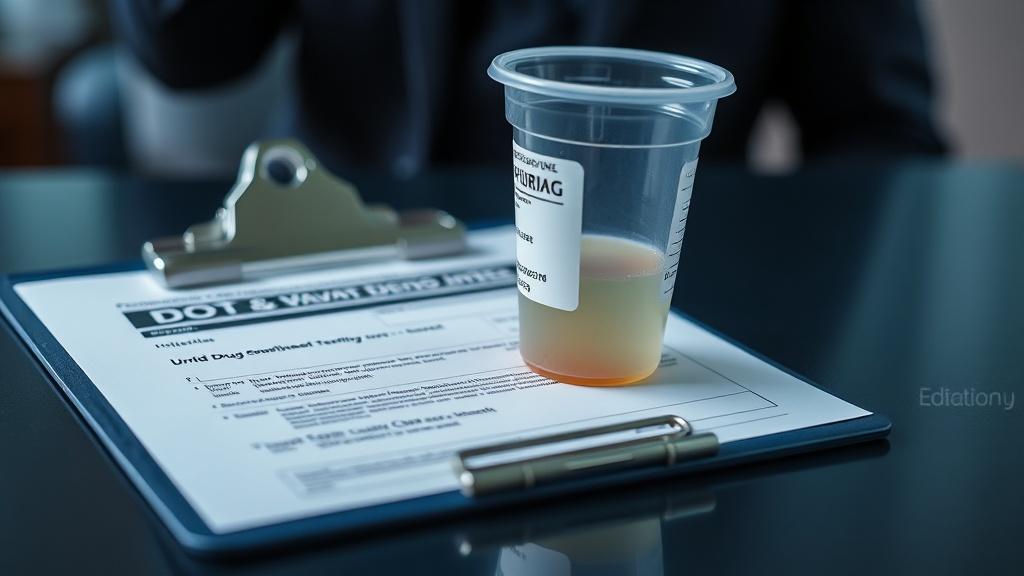
DOT urine specimen collection must be performed by a trained, qualified collector following strict chain-of-custody procedures. The collection process includes identity verification, specimen integrity checks, proper documentation on the Federal CCF, and secure shipping to a SAMHSA-certified laboratory.
Urine Collection Steps
- Collector verifies donor identity with a valid photo ID
- Donor removes outer garments and empties pockets
- Donor provides a specimen in a secure, private setting
- Collector checks specimen temperature (90-100 degrees F within 4 minutes)
- Specimen is split into two bottles (A and B) in the donor's presence
- Both bottles are sealed with tamper-evident labels signed by the donor
- Federal CCF is completed and signed by both collector and donor
- Specimens are packaged and shipped to the SAMHSA-certified laboratory
Directly Observed Collections
Certain situations require a directly observed collection, where a same-gender observer watches the donor provide the specimen. Direct observation is mandatory for return-to-duty and follow-up tests, when a specimen is reported as substituted or invalid, when specimen temperature is out of range, or when there are other indications of tampering. The observer must be the same gender as the donor and must watch the entire voiding process.
Medical Review Officer (MRO) Review
Every DOT drug test result must be reviewed by a licensed Medical Review Officer before being reported to the employer. The MRO is a licensed physician with specialized knowledge of substance abuse disorders and DOT testing regulations. The MRO's role is to provide a final determination on whether a laboratory-confirmed positive, substituted, or invalid result has a legitimate medical explanation.
When a laboratory reports a confirmed positive result, the MRO conducts a verification interview with the donor. During this interview, the donor has the opportunity to present a legitimate medical explanation, such as a valid prescription for the detected substance. The MRO verifies the prescription and determines whether it explains the laboratory finding.
If the MRO finds a legitimate medical explanation, the result is reported as negative to the employer. If there is no legitimate explanation, the result is reported as a verified positive. The donor also has the right to request a split specimen (Bottle B) test at a different SAMHSA-certified laboratory, which must be requested within 72 hours of notification.
Requirements by DOT Agency
While 49 CFR Part 40 provides uniform testing procedures, each of the six DOT agencies has its own specific regulations governing who must be tested, when testing is required, and any additional agency-specific requirements.
FMCSA — Federal Motor Carrier Safety Administration
49 CFR Part 382
Regulates CDL holders performing safety-sensitive functions in commercial motor vehicles. Requires pre-employment, random, post-accident, reasonable suspicion, return-to-duty, and follow-up testing. Random rates are 50% for drugs and 10% for alcohol. Employers must also conduct FMCSA Clearinghouse queries.
FAA — Federal Aviation Administration
14 CFR Part 120
Covers safety-sensitive aviation employees including flight crew, aircraft dispatchers, maintenance personnel, ground security coordinators, and aviation screeners. Random rates are 25% for drugs and 10% for alcohol. Pre-employment alcohol testing is permitted.
FTA — Federal Transit Administration
49 CFR Part 655
Applies to employees of recipients and sub-recipients of FTA funding who perform safety-sensitive functions in public transit operations. Random rates are 50% for drugs and 10% for alcohol (FTA notice, January 2026). Pre-employment alcohol testing is optional under 49 CFR 655.42.
FRA — Federal Railroad Administration
49 CFR Part 219
Covers railroad employees in safety-sensitive positions including engineers, conductors, signal maintainers, and dispatchers. FRA has unique post-accident testing criteria and also conducts its own random testing programs for certain employee categories.
PHMSA — Pipeline and Hazardous Materials Safety Administration
49 CFR Part 199
Regulates employees who perform operations, maintenance, and emergency response functions on natural gas and hazardous liquid pipelines. Random rates are 50% for drugs and 10% for alcohol.
USCG — United States Coast Guard
46 CFR Parts 4 & 16
Covers crewmembers on commercial vessels who hold merchant mariner credentials. The USCG has unique serious marine incident testing requirements and periodic testing for mariner credentialing. Random rates are 50% for drugs and 10% for alcohol.
Penalties for Non-Compliance
DOT agencies take compliance seriously and conduct audits to verify that employers maintain compliant programs. Violations can result in significant civil penalties, which are charged per violation and vary by agency. FMCSA's schedule states the maximums: up to $19,246 for a non-recordkeeping testing violation by an employer, $4,812 where the driver is the violator, $7,155 for a Clearinghouse or CDL violation, and $1,584 for each day a required record is missing, up to $15,846 — 49 CFR Part 386, Appendix B, paragraphs (a)(3), (a)(4), (b) and (a)(1), as amended through July 21, 2026. Each is a ceiling the rule sets rather than a typical amount, they are charged per violation, and the amounts are adjusted for inflation.
Common audit findings include failure to conduct pre-employment testing, incomplete random testing pools, missing supervisor training records, failure to conduct Clearinghouse queries, and inadequate record retention. In severe cases, carriers can be placed out of service, effectively shutting down operations until compliance is restored.
Beyond regulatory penalties, employers face significant liability exposure when they fail to maintain compliant testing programs. If an untested or improperly tested employee is involved in an accident, the employer's failure to comply with DOT testing requirements can be used as evidence of negligence in civil litigation, resulting in potentially catastrophic damage awards.
Frequently Asked Questions
How often does DOT require random drug testing?
+
Most DOT agencies require that the annual random testing rate be 50% of the average number of safety-sensitive employees for drugs and 10% for alcohol. These rates are set annually by each agency and can change based on industry positive test rates. Employers must spread their random selections reasonably throughout the calendar year.
What happens if an employee refuses a DOT drug or alcohol test?
+
A refusal to test is treated the same as a positive test result under DOT regulations. Refusals include failing to appear for testing, leaving before the process is complete, failing to provide an adequate specimen without a valid medical explanation, and tampering with a specimen. The employee must be immediately removed from safety-sensitive duties and referred to a Substance Abuse Professional (SAP).
Does DOT test for marijuana even in states where it is legal?
+
Yes. DOT drug testing is a federal program, and marijuana remains a Schedule I controlled substance under federal law. State or local legalization of marijuana — whether medical or recreational — has no bearing on DOT testing requirements. A positive THC result on a DOT test is a violation regardless of the employee's state of residence or any state cannabis laws.
Need Help With Your DOT Testing Program?
ABW Compliance Services manages every aspect of DOT drug and alcohol testing for employers nationwide. Get a free compliance assessment today.
Get a Free Compliance AssessmentGet a Free Quote
Recent Posts
- Return-to-Duty Process: Complete Guide for Employers (2026)May 12, 2026
- Reasonable Suspicion Training: What Supervisors Need to Know (2026)May 12, 2026
- DOT Post-Accident Drug & Alcohol Testing: Employer Guide (2026)May 12, 2026
- DOT Compliance for Owner-Operators: Getting Started Guide (2026)May 12, 2026
- Oral Fluid Testing: DOT-Approved Saliva Drug Testing Guide (2026)May 12, 2026