
Complete guide to building a compliant drug-free workplace program. Covers DOT-mandated and voluntary programs, written policies, employee education, supervisor training, testing requirements, federal contractor obligations, and state law considerations.
Audio Summary
2:37
Listen: Drug-Free Workplace Guide
Narrated by Catherine · DOT Compliance Educator
0:00
2:37
Click play to load audio
What Is a Drug-Free Workplace Program
A drug-free workplace program (DFWP) is a structured set of policies, procedures, and activities designed to eliminate substance abuse from the workplace. At its core, a DFWP establishes clear rules about drug and alcohol use, defines the consequences of violations, provides resources for employees who need help, and implements testing protocols to enforce the policy.
Drug-free workplace programs serve multiple purposes: they protect employee safety, reduce workplace accidents and injuries, lower workers' compensation costs, improve productivity, reduce employer liability, and ensure compliance with applicable federal and state regulations. For DOT-regulated employers, having a compliant program is not optional—it is a federal requirement that is enforced through audits and civil penalties.
Who Needs a Drug-Free Workplace Program
Several categories of employers are required by law to maintain a drug-free workplace program. Even employers who are not legally required to have one often benefit significantly from implementing a voluntary program.
- DOT-regulated employers: Any employer with safety-sensitive employees regulated by FMCSA, FAA, FTA, FRA, PHMSA, or USCG must maintain a DOT-compliant drug and alcohol testing program
- Federal contractors and grantees: Organizations receiving federal contracts of $100,000 or more, or any federal grant, must comply with the Drug-Free Workplace Act of 1988
- Department of Defense contractors: DOD contractors with access to classified information must maintain substance abuse prevention programs
- Department of Energy contractors: DOE contractors at certain facilities must maintain fitness-for-duty programs including drug testing
- Nuclear Regulatory Commission licensees: NRC licensees must maintain fitness-for-duty programs for workers with unescorted access
- State-regulated employers: Many states offer workers' compensation premium discounts or other incentives for employers who maintain certified drug-free workplace programs
DOT-Mandated Programs vs Voluntary Programs
There are fundamental differences between a DOT-mandated drug and alcohol testing program and a voluntary employer program. Understanding these differences is critical, especially for employers who need both.
DOT-Mandated Programs
- Governed by 49 CFR Part 40 and agency-specific regulations
- Standard 5-panel drug test (specific substances mandated)
- Testing rates set by DOT agencies (typically 50% drugs, 10% alcohol)
- Must use SAMHSA-certified laboratories
- MRO review required for all drug tests
- SAP referral mandatory after violations
- Specific collector qualifications required
- Federal CCF and ATF forms required
- Clearinghouse reporting required (FMCSA)
- Cannot add substances to the panel
Voluntary (Non-DOT) Programs
- Governed by state law and company policy
- Employer chooses the testing panel (can include additional substances)
- Employer sets testing rates and frequency
- Laboratory and MRO requirements vary by state
- Consequences of violations set by company policy
- SAP referral at employer's discretion
- More flexibility in collection methods
- Non-federal chain-of-custody forms
- No Clearinghouse reporting
- Can test for additional substances (e.g., synthetic opioids, barbiturates)
Many employers operate both programs simultaneously—a DOT program for safety-sensitive employees and a separate non-DOT program for all other employees. These programs must be kept strictly separate. A DOT test cannot be used to satisfy non-DOT requirements, and non-DOT test results cannot be reported to the Clearinghouse.
Key Components of a Compliant Program
Whether mandated by DOT or implemented voluntarily, an effective drug-free workplace program requires five essential components working together. Omitting any of these components creates compliance gaps and reduces the program's effectiveness.
1. Written Policy
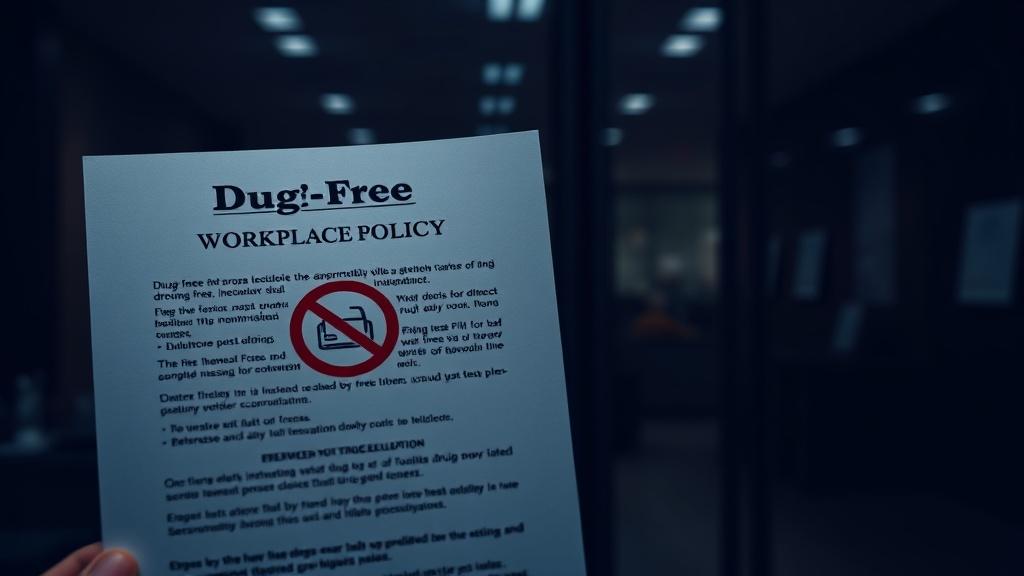
The foundation of any drug-free workplace program is a comprehensive written policy. For DOT programs, the policy must describe the types of testing conducted, the substances tested for, the consequences of a positive test or refusal, the employee's right to a split specimen test, and information about the SAP process. The policy must be distributed to every safety-sensitive employee before they begin covered duties.
2. Employee Education
All covered employees must receive education about the drug and alcohol policy, the dangers of substance abuse in the workplace, and the resources available for help. For DOT programs, employees must receive a copy of the written policy and must acknowledge receipt in writing. Education should cover what substances are tested, how testing works, what constitutes a refusal, and the consequences of violations.
3. Supervisor Training
DOT regulations require that all supervisors who may determine whether an employee must be tested based on reasonable suspicion receive specific training. This training must include at least 60 minutes on the physical, behavioral, and performance indicators of probable drug use and at least 60 minutes on the indicators of probable alcohol misuse. Training must be documented and updated periodically.
4. Employee Assistance Program (EAP)
An EAP provides confidential assessment, referral, and short-term counseling services for employees dealing with substance abuse and other personal issues. For DOT programs, employers must provide access to SAP services following a violation. Many employers also maintain a broader EAP that employees can access voluntarily before issues escalate to a violation.
5. Drug and Alcohol Testing
The testing component implements the five DOT test categories (pre-employment, random, post-accident, reasonable suspicion, and return-to-duty/follow-up) or the testing categories defined in the employer's voluntary program. Testing must be conducted following established procedures, using qualified personnel, and with proper chain-of-custody documentation.
DOT vs Non-DOT Policy Differences
Employers who maintain both DOT and non-DOT programs must understand the key differences and keep the programs operationally separate. Common areas where confusion arises include the testing panel, marijuana policies, and consequences of violations.
The DOT testing panel is fixed at five substance categories and cannot be modified by the employer. Non-DOT programs can test for any substances permitted under state law, including expanded opioid panels, barbiturates, benzodiazepines, and synthetic cannabinoids. Some employers add fentanyl to their non-DOT panel given its prevalence in the current drug landscape.
Marijuana policy is a particularly important distinction. DOT testing always includes THC regardless of state legalization. For non-DOT programs, employers in states with recreational or medical marijuana laws may need to modify their policies to comply with state employment protections. Some states prohibit adverse employment action based solely on a positive marijuana test for non-safety-sensitive positions. Employers must navigate this patchwork of state laws carefully.
Drug-Free Workplace Act for Federal Contractors
The Drug-Free Workplace Act of 1988 requires all organizations receiving federal contracts of $100,000 or more, and all recipients of any federal grant, to certify that they maintain a drug-free workplace. This requirement is separate from DOT testing requirements and applies broadly across all industries.
Requirements Under the Act
- Publish a written statement notifying employees that unlawful drug activity in the workplace is prohibited
- Specify the actions that will be taken against employees who violate the policy
- Establish a drug-free awareness program covering the dangers of workplace drug abuse, the employer's policy, available counseling and rehabilitation, and penalties for violations
- Require each employee engaged in contract work to receive a copy of the policy and agree to abide by it
- Notify the contracting agency within 10 days of learning about an employee's criminal drug conviction for workplace conduct
- Take appropriate action against convicted employees within 30 days
- Make a good-faith effort to maintain a drug-free workplace
Notably, the Drug-Free Workplace Act does not require drug testing. It focuses on policy, education, and reporting. However, many federal contractors implement testing programs as part of their good-faith compliance efforts, and some specific contracting agencies require testing as a condition of the contract.
State Law Considerations
Drug testing in the workplace is regulated at the state level in addition to federal requirements. State laws vary dramatically and can significantly impact how employers design and implement their drug-free workplace programs. Employers with operations in multiple states face particular challenges in maintaining consistent but legally compliant programs.
Key areas where state laws differ include: which types of testing are permitted (pre-employment, random, post-accident, reasonable suspicion), notice requirements before testing, specimen types allowed, consequences employers can impose for positive results, marijuana employment protections, and whether employees have the right to retest or contest results.
Several states offer Drug-Free Workplace premium discount programs that provide workers' compensation insurance savings to employers who maintain certified programs meeting specific state criteria. These discount programs typically require a written policy, employee education, supervisor training, EAP access, and regular testing. The size of the discount varies by carrier and by state, so ask your own insurer what documentation they want to see.
How to Roll Out a New Program: 30-Day Timeline
Implementing a new drug-free workplace program requires careful planning and execution. Rushing the process creates compliance gaps, while delaying leaves the employer exposed. The following 30-day timeline provides a structured approach to launching a compliant program.
Week 1: Policy Development
Draft or customize the written drug and alcohol policy. Identify all safety-sensitive positions subject to DOT testing. Determine whether a non-DOT program is also needed. Review applicable state laws for each state of operation. Engage legal counsel to review the draft policy.
Week 2: Infrastructure Setup
Select and contract with a C/TPA (Consortium/Third-Party Administrator) such as ABW. Establish relationships with collection sites and mobile collectors. Set up the random testing pool and selection system. Contract with a SAMHSA-certified laboratory and MRO. Register with the FMCSA Clearinghouse if applicable.
Week 3: Training and Education
Conduct supervisor reasonable suspicion training (minimum 2 hours for DOT). Distribute the written policy to all covered employees and obtain signed acknowledgments. Conduct employee education sessions covering policy requirements, testing procedures, and available resources. Set up EAP access.
Week 4: Go-Live
Begin pre-employment testing for new hires. Activate the random testing program with the first selections. Conduct pre-employment Clearinghouse queries for all current CDL drivers. Verify all documentation is complete and properly filed. Conduct a final compliance audit of the program before declaring it operational.
Cost of Non-Compliance
The financial and operational costs of failing to maintain a compliant drug-free workplace program are substantial and multi-layered. Employers who view compliance as optional are taking significant risks that far exceed the cost of implementing and maintaining a proper program.
Regulatory Fines
FMCSA civil penalty amounts are published in its own schedule at 49 CFR Part 386, Appendix B and re-set for inflation every year, and the schedule states the maximums: up to $19,246 per non-recordkeeping testing violation by an employer, paragraph (a)(3), and $1,584 for each day a required record is missing up to $15,846, paragraph (a)(1), as amended through July 21, 2026. Both are ceilings the rule allows, not averages. A single audit routinely cites several violations, and each is charged separately. Other DOT agencies publish their own penalty schedules. These fines apply per violation, per employee, and can accumulate rapidly.
Operational Shutdown Risk
In severe cases, DOT agencies can issue out-of-service orders that halt operations until compliance is restored. For carriers and fleet operators, an out-of-service order means vehicles cannot operate, loads cannot be delivered, and revenue stops immediately.
Insurance Impacts
Insurance carriers increasingly require proof of a compliant drug-free workplace program. Non-compliance can result in policy exclusions, increased premiums, or cancellation. After an accident involving an untested employee, insurance coverage may be denied based on the employer's failure to comply with testing requirements.
Litigation Exposure
If an accident occurs involving an employee who should have been tested but was not, the employer's failure to maintain a compliant program becomes a powerful liability argument. Plaintiffs' attorneys routinely use testing program deficiencies as evidence of negligence, which can lead to damage awards far exceeding any regulatory fine.
Lost Contracts
Many shippers, brokers, and general contractors require proof of a compliant drug testing program as a condition of doing business. Loss of compliance status can mean loss of contracts and revenue. Federal contractors risk debarment from future contract opportunities.
How ABW Builds Programs From Scratch
ABW Compliance Services specializes in building complete, audit-ready drug-free workplace programs for employers of all sizes. Whether you are a single-truck owner-operator or a fleet with hundreds of drivers, we deliver a fully operational program on a timeline we agree with you up front.
- Custom written drug and alcohol policy tailored to your operations, state requirements, and DOT agency regulations
- Complete C/TPA enrollment including random pool setup, selection management, and consortium membership for small employers
- National collection site network access and mobile collection
- SAMHSA-certified laboratory services and contracted MRO review
- Supervisor reasonable suspicion training (DOT-compliant, available in-person or online)
- Employee education materials and signed acknowledgment tracking
- FMCSA Clearinghouse registration assistance and query management
- Complete record-keeping system with audit-ready documentation
- Ongoing compliance management including random selections, result tracking, and regulatory updates
Every program we build is designed to withstand a DOT audit from day one. We do not use generic templates—each program is customized to the employer's specific operational requirements, regulatory obligations, and state law environment.
Frequently Asked Questions
How much does it cost to set up a drug-free workplace program?
+
Costs vary depending on the size of the employer, the number of safety-sensitive employees, the testing volume, and whether DOT and/or non-DOT programs are needed. ABW offers bundled program packages that include policy development, C/TPA services, random pool management, and testing. Contact us for a customized quote based on your specific needs.
Can I use the same policy for DOT and non-DOT employees?
+
No. DOT and non-DOT testing programs must be kept separate. You may include both programs in a single policy document, but the DOT and non-DOT sections must be clearly distinguished. A DOT test result cannot be used for non-DOT purposes, and non-DOT test results cannot be reported to the Clearinghouse.
What about states that have legalized marijuana?
+
For DOT-regulated employees, marijuana testing is required regardless of state legalization. For non-DOT employees, the answer depends on the state. A growing number of states restrict employers from taking adverse action based solely on a positive marijuana test for non-safety-sensitive positions. Your drug-free workplace policy must be reviewed by legal counsel familiar with the specific laws of each state where you operate.
Do I need a drug-free workplace program if I only have one driver?
+
Yes. If you have even one CDL driver performing safety-sensitive functions under DOT regulations, you must maintain a fully compliant drug and alcohol testing program. Small employers typically join a consortium (C/TPA) like ABW to meet random testing pool requirements and access the full range of compliance services at a manageable cost.
Ready to Build Your Drug-Free Workplace Program?
ABW Compliance Services builds complete, audit-ready drug-free workplace programs from scratch. Get started with a free compliance assessment today.
Get a Free Program AssessmentGet a Free Quote
Recent Posts
- Return-to-Duty Process: Complete Guide for Employers (2026)May 12, 2026
- Reasonable Suspicion Training: What Supervisors Need to Know (2026)May 12, 2026
- DOT Post-Accident Drug & Alcohol Testing: Employer Guide (2026)May 12, 2026
- DOT Compliance for Owner-Operators: Getting Started Guide (2026)May 12, 2026
- Oral Fluid Testing: DOT-Approved Saliva Drug Testing Guide (2026)May 12, 2026